2026-10-28
Most bonding failures on a PET EVA line are not caused by the film itself. They are caused by a purchase order that specified thickness but never mentioned EVA coat weight. Two rolls can both be labelled "35 microns" and still behave completely differently: one seals at 95 degrees Celsius with a 10 N/25 mm peel, the other needs 115 degrees and leaves a hazy edge that lifts after die-cutting.
The short version first: PET EVA laminating film is a two-layer construction, a biaxially oriented PET carrier plus a hot-melt EVA sealant, and nearly every performance decision lives in the EVA layer. Fix the PET gauge, the EVA coat weight in grams per square metre, the activation window and a peel target before anyone discusses surface finish. The sections below explain what each number changes on the line, and where the real purchasing risks sit.
The film is built from two extruded layers bonded in a single pass:
That structure is why PET EVA behaves differently from BOPP EVA. BOPP is softer and cheaper per square metre, and it remains the right answer for flexible book covers and light office pouches. PET holds a flatter sheet, resists curl better on heavy board and keeps its gloss after repeated handling, which is why rigid cards, menus, ID badges and premium packaging tend to be specified in PET.
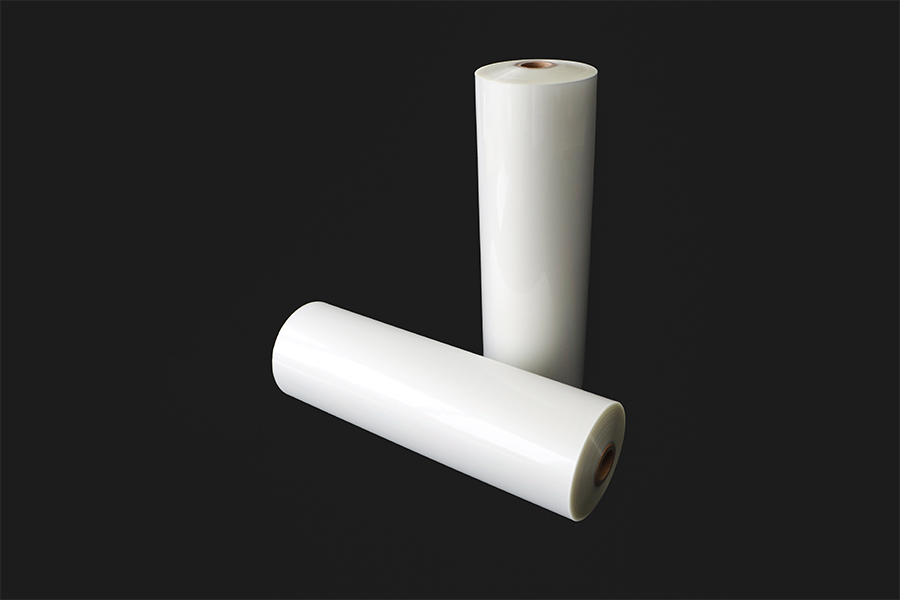 BOPET EVA Thermal Laminating Roll FilmPET-based EVA roll film for printed sheets, combining flatness and gloss with lower-temperature bonding for rigid cards, menus and premium packaging.View Product →
EVA copolymer softens and flows roughly 25 to 35 degrees Celsius below LDPE extrusion coatings, and around 45 degrees below PP-based sealants. On a roll laminator that gap translates into three practical effects: faster line speed because the roller needs a shorter dwell time to reach bond temperature, less thermal stress on the substrate so coated paper and digitally printed sheets are far less likely to curl or blister, and a wider process window on low-energy surfaces such as UV-cured offset inks.
The trade-off is worth stating plainly. EVA is softer than LDPE, so the finished laminate has lower heat resistance and a higher blocking risk if rolls are stored warm. It is also more moisture-sensitive before use. Neither problem is fatal, but both belong in your storage and handling instructions rather than in a complaint six months later.
Thickness alone is a weak specification. The table below lists the parameters that actually determine whether a roll performs on your machine.
| Parameter | Typical range | What it changes |
|---|---|---|
| PET carrier thickness | 12 to 23 microns | Stiffness, curl resistance and gloss retention; thicker PET resists edge lift on heavy board. |
| EVA coat weight | 15 to 40 g/m2 | Peel strength and minimum sealing temperature. Below about 18 g/m2 bond strength drops quickly. |
| Total film thickness | 25 to 75 microns | Hand feel and cost. It is the number most buyers quote and the least informative one on its own. |
| Activation temperature | 85 to 105 C | Roller setting and line speed. Too low gives a weak bond; too high causes curl and orange-peel texture. |
| Peel strength on coated paper | 8 to 12 N/25 mm | Whether the edge lifts after die-cutting, folding or scoring. |
| Core, width and roll length | 25.4 or 76 mm core; 300 to 1,600 mm width | Machine fit, changeover frequency and waste at the roll end. |
Coat weight is the lever most buyers underestimate. Peel strength climbs steeply between 15 and 25 g/m2, then flattens out: paying for 36 g/m2 on a smooth coated board usually buys very little extra adhesion compared with 28 g/m2. If you want a deeper look at how thickness is defined and measured, this note on the essence of laminating film thickness is a useful reference.
Finish is the last decision, not the first. Once the carrier gauge and coat weight are fixed, the surface treatment determines how the laminated sheet looks and how it survives handling. Gloss is the default for menus, book covers and retail cards because it deepens print contrast. Matte and silk-touch finishes reduce glare and fingerprint marks, which matters on touch-heavy items such as menus and control panels. Crystal-clear grades are chosen when the film sits over a white or light print and any haze would grey the image.
Beyond appearance, functional grades solve specific process problems: laser-compatible films for toner-based digital printing, dry-erase and whiteboard films for reusable surfaces, hard-coat and scratch-resistant films for cards that pass through many hands, anti-static films for cleanroom and electronics documentation, anti-UV films for outdoor signage, and separable films for temporary protection that must peel away cleanly. Matching the grade to the substrate matters more than matching it to the brochure.
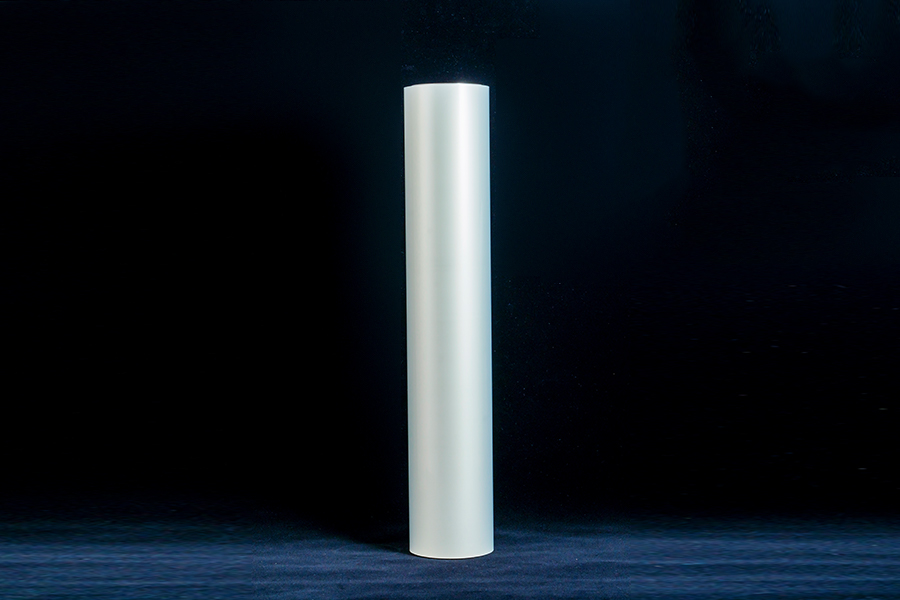 Glossy PET EVA Thermal Laminating FilmHigh-gloss PET/EVA roll film for photo prints, covers and display graphics, offering clarity and surface protection on heated roll laminators.View Product →
Thermal PET EVA remains the cheaper and stronger option per square metre for paper, board and most offset or toner prints. Cold laminating film uses a pressure-sensitive adhesive applied at room temperature, so it is the safer choice when the ink or substrate cannot take heat: photo papers, solvent and latex inkjet prints, heat-sensitive synthetics and on-site finishing where a warm-up cycle is impractical.
A practical rule used by many converters: if the sheet curls after a single pass at 100 C, or if the print contains heavy toner coverage that cracks under heat, switch the job to cold film rather than lowering the roller temperature further. A cold bond that holds is worth more than a thermal bond that looks perfect on the sample and fails on the pallet.
When the substrate is the problem rather than the settings, a higher-bonding grade is the cleaner fix than pushing roller temperature upwards. Films formulated for difficult inks and coated boards exist for exactly this reason, and they solve edge lift without the curl penalty that comes with extra heat.
 High-Bonding Thermal Laminating Film for Difficult PrintsTackified laminating film for digital toner, oil-based photo prints and heavy ink coverage, helping prevent edge lift and delamination on difficult substrates.View Product →
Roll-to-roll consistency is what separates a supplier from a sample. Ask for the coat weight tolerance band, the peel test method used, batch traceability back to the extrusion run, the splice policy per roll, and a written storage recommendation covering temperature, humidity and shelf life. These five answers tell you more about a factory than a catalogue.
Capacity and equipment matter too. WONLAMI, for example, operates 10 extrusion coating and laminating lines across its China and Thailand sites with annual output above 30,000 tonnes and more than 25 years of extrusion coating experience; the company and factory profile lists the equipment and certificate coverage in more detail. For a buyer running a continuous converting line, that kind of redundancy is what prevents a single-site shutdown from becoming your shutdown.
Wholesale Laminating Film Roll Manufacturers





 English
 русский
 Español
 Português