2026-05-20
In the laminating film industry, "thickness" is a crucial technical parameter that users must understand. 80mic, 100mic, 125mic, 150mic…
These numbers may seem like mere differences in product specifications, but from a materials engineering perspective, thickness actually determines the structural strength, bending resistance, durability, and final user experience of the laminated product.
Interestingly, in practical applications, people's understanding of thickness often falls into two extremes: one is that "the thicker the better,"; the other is that "as long as it can be laminated, it's fine."
In fact, neither of these understandings is accurate. Thickness is never an independent parameter, but rather an important component of the laminating film's structural design. A truly reasonable thickness selection involves material properties, the usage environment, and product lifecycle management.
I. From a structural perspective, what exactly does thickness change?
Laminating film is typically composed of a PET base layer and an EVA hot melt adhesive layer. After lamination, the paper is no longer just paper, but forms a typical "sandwich structure."
This structure shares a similar logic with laminated glass and honeycomb panels in architecture: the PET layer provides primary support; the EVA layer handles bonding and cushioning; and the paper itself becomes the core layer of the structure.
In materials mechanics, the bending stiffness of a structure increases geometrically with each increase in thickness, rather than linearly.
This means that when the laminating film increases from 80 micrometers to 125 micrometers, the perceived increase in stiffness is far greater than the change in the thickness figure itself. Therefore, the most intuitive impression of thicker films is not "thicker," but rather: • stiffer • more • more supportive
These characteristics are precisely the structural strengthening result of the thickness change.
II. The First Dimension of Thickness's Impact: Service Life
If laminating products are considered as long-term materials, then thickness primarily affects the durability period.
Paper mainly faces four types of damage during use: • Edge abrasion • Surface scratches • Crease fatigue • Environmental aging
While thinner sheets can provide basic protection, their surface wear rate increases significantly under long-term, high-frequency contact.
For example: teaching cards are flipped through dozens of times a day; restaurant menus are constantly exposed to oil stains and friction; production boards are continuously touched. In these cases, the material is no longer facing one-time protection, but rather continuous mechanical stress.
From a lifespan perspective: 80mic and 100mic are suitable for general document protection; 125mic and above begin to have long-term use value; and 150mic and above can meet the durability requirements of high-frequency contact environments. Therefore, higher thickness essentially extends the effective lifespan of the product.
III. The Second Dimension of Thickness's Impact: Visual Performance
Many users believe that laminating film only provides protection. In fact, in display scenarios, laminating film also serves a visual optimization function. Especially in applications such as posters, display boards, menus, company materials, and teaching charts, thickness directly affects flatness.
The reason is simple. Paper itself is hygroscopic; changes in environmental humidity cause paper fibers to expand and contract slightly. When the film layer lacks rigidity, this change is amplified, manifesting as: • Wavy edges • Curling • Corner warping
A thicker PET layer provides stronger dimensional stability.
Therefore, for display materials, thickness determines not only protective capabilities but also visual quality. Many large supermarkets, educational institutions, and chain stores choose thicknesses of 150 mic or higher precisely for this reason.
IV. The Conflicting Relationship Between Thickness and User Experience
Increasing thickness does not necessarily mean a simultaneous improvement in all performance aspects. In fact, in many application scenarios, excessive thickness can actually reduce the user experience.
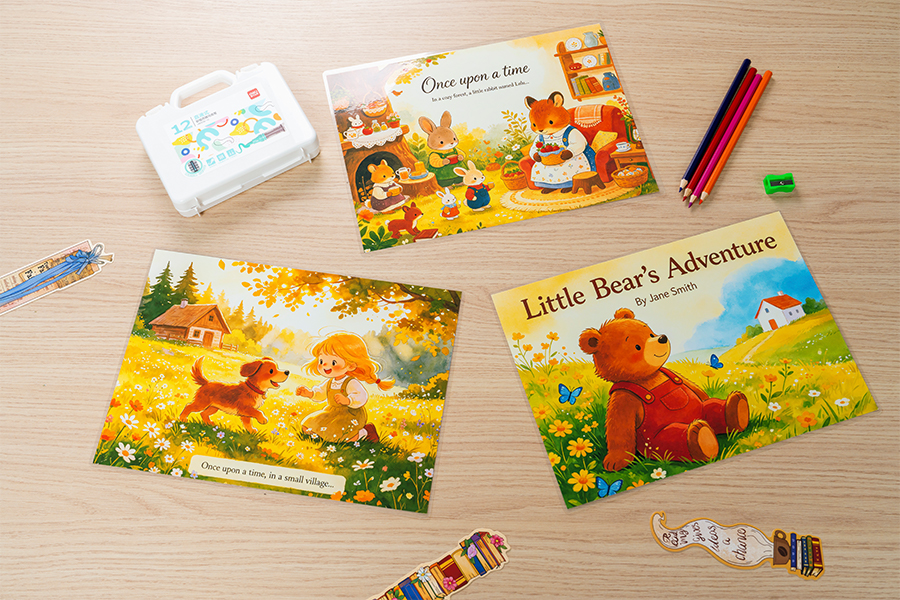
For example, in the creation of quiet books. Users need to frequently turn pages, fold, and trim. If a 175 mic or even 250 mic product is used: the page becomes stiff; turning resistance increases; and edge trimming becomes more difficult. The same problem occurs in scenarios such as: journaling, DIY creative products, and card decoration.
These applications prioritize: • Flexibility • Freedom of operation • Tactile experience
rather than extreme protective capabilities.
Therefore, thickness selection is not simply about maximizing performance, but about finding a balance between protection and ease of use.
V. Beyond Thickness, Thickness Stability is More Important
There is an often overlooked issue in the industry: products labeled as 125 mic can have completely different actual user experiences. The reason is that users see the thickness numerical value, but what truly affects quality during the production process are: • PET thickness uniformity • EVA coating precision • Thickness tolerance control • Heat sealing shrinkage rate
If these indicators are not well controlled, even with the same nominal thickness, issues such as bubbling, ripples, uneven sealing, and edge lifting may occur.
For professional manufacturers, thickness management is never simply about increasing material usage, but about ensuring stability down to the micrometer. This is also one of the important standards for measuring the quality of laminating film.
Today, thickness in laminating film is no longer just a product parameter. It reflects a comprehensive balance between usage frequency, storage period, display needs, operating habits, and cost control.
For ordinary office documents, moderate thickness is sufficient; for materials intended for long-term display, stability is more important; for high-frequency usage scenarios, durability becomes the core indicator. This is the most important technical logic to consider when selecting laminating film.
As a professional manufacturer with nearly 30 years of experience in extrusion lamination, Kingmax Molding relies on mature extrusion lamination technology and a comprehensive quality management system to achieve full-process quality control from raw materials to finished products. Product thicknesses cover a variety of specifications, including 80mic, 100mic, 125mic, 150mic, and 175mic, and customized solutions can be provided according to customer application needs.
For Kingmax Molding, thickness is merely an external manifestation of product performance. A stable PET substrate, a uniform EVA adhesive layer, and a mature extrusion lamination process are the core foundations determining the quality of the lamination film. Different thicknesses correspond to different application scenarios; only by precisely matching material properties with actual needs can the true value of the lamination film be realized.
Wholesale Laminating Film Roll Manufacturers





 English
 русский
 Español
 Português